
What to Expect in LGBTQ+ Affirming Therapy | Happy Apple NYC
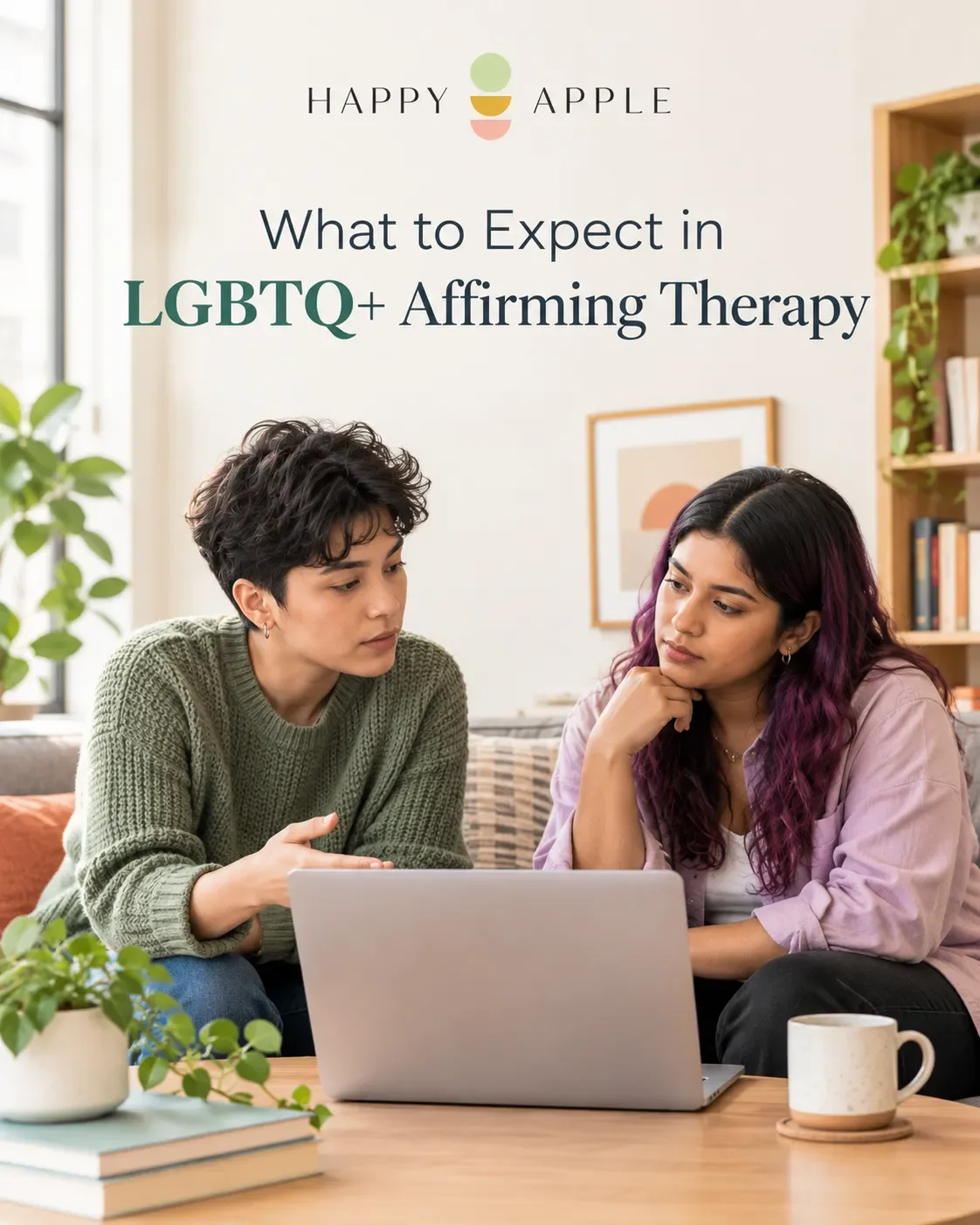
Finding a therapist who genuinely understands LGBTQ+ experiences can make a meaningful difference in how comfortable you feel during therapy. You should not have to spend your sessions explaining your identity, correcting assumptions, or worrying about whether your therapist will judge an important part of who you are.
At Happy Apple NYC, LGBTQIA+ therapy provides an affirming space to explore identity, relationships, emotional health, and life challenges without treating your sexual orientation or gender identity as something that needs to be changed. Care is personalized to your experiences, goals, and circumstances, whether you are seeking individual therapy, couples therapy, or support around a specific transition or concern.
What Does LGBTQ+ Affirming Therapy Mean?
Affirming therapy goes beyond simply being welcoming to LGBTQ+ clients.
It means your therapist understands that your identity is a valid part of who you are and does not approach it as a problem to diagnose or fix. It also means therapy can acknowledge the impact that experiences such as discrimination, family rejection, coming out, minority stress, or societal expectations may have on your emotional well-being.
At Happy Apple, therapists provide LGBTQIA+ care across a range of identities, including lesbian, gay, bisexual, transgender, queer and questioning, intersex, asexual, aromantic, and agender clients.
Your identity does not have to be the focus of every session. Therapy can address whatever brought you there.
Your Therapy Starts With Your Experience
You do not have to arrive knowing exactly what you need from therapy.
During the initial conversations, your therapist will learn about what is happening in your life, what you would like support with, and what you hope to accomplish through therapy.
You might be seeking support because you are:
Exploring your sexual orientation or gender identity
Thinking about coming out
Dealing with family reactions to your identity
Experiencing anxiety or depression
Struggling with self-esteem or self-acceptance
Navigating a gender transition
Working through relationship difficulties
Recovering from bullying, discrimination, or rejection
Processing trauma
Managing stress related to identity or relationships
Going through a major life transition
You can also come to therapy for something that has nothing specifically to do with being LGBTQIA+. Your therapist can support you with the concerns that matter most to you.
What Happens in Your First LGBTQ+ Therapy Session?
Your first session is primarily about getting to know each other and understanding what brings you to therapy.
You may talk about your current concerns, personal history, relationships, identity, goals, and any challenges you would like to address. You can also ask questions about your therapist's approach and what therapy may look like.
You are not expected to disclose everything immediately.
Therapy should develop at a pace that allows you to feel comfortable enough to be honest. At Happy Apple, the first session is designed to help you and your therapist understand whether the approach feels like the right fit.
You Don't Have to Explain or Defend Your Identity
One of the benefits of working with an LGBTQ+ affirming therapist is having a space where your identity is understood and respected.
You should not have to convince your therapist that your relationship is valid, explain why a particular experience was difficult, or defend the way you identify.
Instead, therapy can focus on what you actually want help with.
For example, if you are struggling with family rejection after coming out, the focus can be on managing the emotional impact, deciding what boundaries you need, and figuring out how you want to move forward.
If you are questioning your gender identity, therapy can give you space to explore your feelings without pressure to arrive at a predetermined answer.
If you are experiencing anxiety, depression, or low self-esteem, those concerns can be addressed directly while still considering the context of your identity and experiences.
Support Around Coming Out
Coming out can bring relief, excitement, fear, uncertainty, or a mixture of emotions.
There is no single correct way to come out, and you do not have to follow someone else's timeline.
Therapy can provide a private space to think through questions such as:
Who do I want to tell?
What am I worried might happen?
How might my family respond?
What boundaries do I need?
What support will I need afterward?
How do I want to handle different reactions?
Happy Apple specifically provides support around coming out and recognizes that the experience can be deeply personal and different for every client.
Support for Gender Identity and Transition
If you are questioning your gender identity or navigating a transition, therapy can give you space to explore the emotional and practical aspects of that experience.
You may want to talk about changes in relationships, family dynamics, self-image, social experiences, or other aspects of your life.
Affirming therapy does not require you to have everything figured out before you begin.
Your therapist can meet you where you are and help you explore what you need at your own pace.
LGBTQ+ Therapy Can Address More Than Identity
Your identity may be an important part of your experience, but it does not have to define your therapy.
Happy Apple provides individual therapy for concerns including anxiety, depression, relationship issues, self-esteem, trauma, substance misuse, life transitions, and personal growth. LGBTQ+ identity and coming out are also among the concerns addressed through individual therapy.
This means you can come to therapy because you are struggling at work, having difficulty in a relationship, feeling overwhelmed, dealing with grief, or simply wanting to understand yourself better.
Your therapist can consider the whole picture rather than reducing your experience to your identity.
LGBTQ+ Couples Can Also Receive Affirming Care
Happy Apple provides LGBTQIA+ couples therapy for partners who want support with communication, trust, relationship challenges, or major transitions.
An affirming couples therapist does not assume that every relationship follows traditional heterosexual roles or structures. Instead, therapy starts by understanding how your relationship works and what both partners want to change.
This can be especially valuable when couples are navigating identity changes, family acceptance, coming out, intimacy concerns, or other experiences that affect the relationship. For a closer look, read our guide to LGBTQ+ couples therapy in NYC.
Happy Apple also recognizes diverse relationship structures and provides care that is tailored to each couple rather than applying assumptions about what a relationship should look like.
Finding the Right LGBTQ+ Therapist Matters
You may have already had experiences where you felt misunderstood, stereotyped, or expected to educate someone about your identity.
Therapy should not create another version of that experience. That is why it helps to know how to find a therapist in NYC who fits your life, not just your schedule.
At Happy Apple, the process begins with a complimentary 10-minute conversation about your needs, goals, and what you are looking for in a therapist. The practice then thoughtfully matches you with a therapist whose expertise and approach align with your needs.
If the first match does not feel right, Happy Apple states that it will help you find another therapist.
That matters because feeling understood and comfortable with your therapist can affect how openly you are able to engage in therapy.
What LGBTQ Therapy at Happy Apple NYC Looks Like
Happy Apple is a boutique psychotherapy practice in Columbus Circle, Manhattan, with a carefully curated team of clinicians.
The practice offers LGBTQIA+ therapy alongside individual, couples, and family therapy. Treatment approaches across the practice include CBT, DBT, EMDR, EFT, IFS, and other therapeutic approaches, allowing care to be adapted to the client's concerns and goals.
Sessions are available in person at the Columbus Circle office or through secure online therapy in New York, giving you flexibility in how you receive care.
The goal is not to place you into a predetermined LGBTQ+ therapy program. It is to create a therapeutic experience that reflects you.
What You Can Expect From an Affirming Therapist
A supportive LGBTQ+ therapy experience should allow you to:
Talk openly about your identity without fear of judgment
Discuss relationships without assumptions about gender roles
Explore identity questions at your own pace
Process difficult experiences such as rejection or discrimination
Develop strategies for managing anxiety, depression, or stress
Work through family and relationship challenges
Build self-esteem and self-acceptance
Discuss coming out and boundaries
Navigate major life transitions
Set goals that reflect what you actually want for your life
Most importantly, you should feel that therapy is a place where you can be honest.
Start LGBTQ+ Affirming Therapy in NYC
You do not need to wait until you are in crisis to seek affirming therapy.
Maybe you are questioning something about your identity. Maybe you are preparing to come out. Perhaps your family is struggling to accept you, your relationship is going through a difficult period, or you are dealing with anxiety or low self-esteem.
Or perhaps you simply want a therapist who understands LGBTQ+ experiences without making your identity the entire focus of treatment.
Happy Apple NYC offers LGBTQIA+ therapy for individuals and couples in a supportive, affirming environment, with in-person sessions in Columbus Circle and secure online therapy.
You can begin with a complimentary 10-minute consultation to talk about what you are looking for, ask questions, and explore therapist matching.
Frequently Asked Questions
Is LGBTQ+ affirming therapy only for people struggling with their identity?
No. LGBTQ+ clients seek therapy for the same broad range of concerns as anyone else, including anxiety, depression, relationships, stress, trauma, self-esteem, grief, and life transitions. Therapy can take your identity and experiences into account without making them the sole focus.
Do I need to be certain about my sexual orientation or gender identity before starting therapy?
No. If you are questioning your identity, therapy can provide a space to explore your thoughts and feelings without pressure to reach a particular conclusion.
Can I talk about family rejection in therapy?
Yes. Family acceptance, coming out, boundaries, and relationship challenges can all be discussed in LGBTQIA+ therapy at Happy Apple.
Can I receive LGBTQ+ therapy online?
Yes. Happy Apple offers secure online therapy in addition to in-person sessions at its Columbus Circle location.
How do I find the right LGBTQ+ therapist at Happy Apple?
You can begin with a complimentary 10-minute consultation. Happy Apple uses a therapist-matching process designed to connect you with a clinician whose expertise and approach align with your needs and preferences.
